Oh Holy Dark Knight

By Wes Calimer


When I mention Christmas, you automatically think of snow, candy canes, Die Hard, (as you should), eggnog, that jolly fat guy, and Batman, yes?

Not Batman?

Well, shame on you!  Our hero has a lot more in common with the holiday spirit than you might think.  Let us we revisit all the best Christmas-themed tales from Batman: The Animated Series, where we’ll find the similarities in what Christmas and Batman both stand for, and enjoy the whoop-ass he wholeheartedly hands out every season.  So let’s take a trip together, gentle readers, as we look back at the merry adventures of our holy dark knight!

We’ll be delving into one Bat-mas story at a time.  Let’s start things off this week with “Christmas with the Joker.”  I mean, we kinda have to, right?  Christmas is, like, right in the title. Plus, look at his li’l Santa hat! Here are a few things that have always stuck with me about this episode.

A freaking rocket-propelled christmas tree!  Yep, that just happened.  As a way to escape from Arkham Asylum, the Joker either builds a rocket himself, or hires a crew of inmates that are actual rocket scientists, who also happen to be criminally insane, to engineer a functional Christmas monstrosity of death and transportation.

When the sucker takes off with the Joker on top, the twenty or so people below start to scamper away.  But you KNOW that the exhaust must have taken at least half of ‘em out, and who even knows about the aftereffects?  The thing might have been nuclear!

By the way, notice: The Joker and Charles Manson are tight.  You can see Chuck wishing him well right before Joker climbs that bad boy and splits.

Sure, the Joker is crazy, but he’s a problem-solver as well.  Not only did he build a high-powered rocket into a tree, but to do that in a maximum-security prison is pretty impressive.  Then, when he was airborne outside of the prison, he had to take his landing projections into account.  So many variables!

And dude!  Where’d he get all that fuel?!  Do you understand how much fuel a rocket has to have to even achieve liftoff?  I sure as hell don’t, but the Clown Prince of Crime does!  All with a smile on his face! So the guy is either a genius or just disgustingly loaded from all the heists he’s successfully pulled off.  Or both, probably both…

Meanwhile, in the Batcave, Dick’s trying to get Bats in the holiday spirit by pitching the idea of watching It’s a Wonderful Life, and Bruce ain’t hearin it.  I dunno, I’m not going to retell every second of this episode, mostly because I can’t bear to.  Right off the bat (pun intended), the dialogue and dynamics between Batman and Robin feel off.  Kevin Conroy (the voice of Batman) also sounds off:  “The Joker’s escaped from Arkham Asylum, Robin.”

It’s true that the series was just trying to find its footing (with this offering being from very early in its run), but Eddie Gorodetsky, who wrote this episode, comes from a background of mostly half-hour sitcoms and it’s also notable to say that this is the only episode of Batman that he ever wrote, like, ever.  So again, it’s all just a bit off and has a weird tone.

Anyway, Robin bets Batman that if nothing goes wrong on Christmas Eve, they can come back home, eat a goose, and watch It’s a Wonderful Life, all the while KNOWING that the Joker literally JUST escaped from Arkham.  Dick assumes that the Joker just has a holiday family vacation to go to or something…

Batman and Robin go out on the prowl, searching for cats up a tree and crap, find nothing, and head back to the mansion.  Robin compares Batman to Scrooge a few times, ’cause that’s fair.  It’s not like Bruce is a well-known prolific philanthropist or anything.  Plus, the whole serving Gotham as a vigilante every waking moment for justice is kinda greedy.

They get back to the Manor, after all that effort NOT looking for the Joker, since he just escaped! Yo, Batman — you JUST said it!  They begin to watch It’s a Wonderful Life, then all manners of crazy ensue, as Joker takes over the airwaves with his very own Christmas special!  Joker says that Batman and Robin have until midnight to fight their way past his traps and shenaniganery hidden all over town to rescue the kidnapped Commissioner Gordon, Harvey Bullock, and reporter Summer Gleeson (who matters for some reason) — otherwise, they’re dead.

I love the incredibly, ridiculously elaborate measures that Joker goes through every time, no matter what.  Procuring a sound stage, a camera, making sure everything works, drawing and cutting cardboard cut outs of all the people he loves to hate for his audience, planning all these deadly traps, outfitting a Nazi Santa tank … it’s the little things that count and he’s a special kind of crazy.

Oh, one side note: Jim Gordon is a decorated police official, but if you put him up against a candy cane, and especially if said candy cane is in between his lips in an attempt to keep him quiet, he is INCAPABLE of speaking!  He physically can’t muster up the strength to overcome the obstacle of spitting that scrumptious, jolly, piece of evil out of his mouth.

This is a common motif in film and television, and it never fails to irritate me.

“Oh no!  I have a handkerchief in my mouth!  What to dooo?!”  Well, they’re all muffled so it’d probably sound more like “MMMFFFFFMNNNNTTTFF!!!!”

Back to the plot!  Batman and Robin came across six laughing life-sized Joker toys with guns for hands, four deadly model airplanes, three killer giant robot toy soldiers, evade one giant observatory telescope that Joker made into a cannon and a partridge in a pear tree. (which, you remember, he turned into a rocket.)

Wait!  Batman and Robin are looking for Joker’s hideout, jumping through all these insane(ly entertaining) hoops for nothing.  Robin asks, “What’s our next move?!” Batman says “To be quite honest, I don’t know,” then figures out from a discontinued doll that the Joker’s hiding out at the Ol’ LaffCo Toy Factory.

HEY!  “World’s greatest detective!”  From now on, why don’t you just take a head count of all the creepy, ABANDONED factories in Gotham that have giant weird clown faces on the front of them, then demolish them all!  The Joker would then have no choice but to take over a Wal-mart or something.  That’d be weird, though…

After all that, these two henchmen come out from the top of the factory with machine guns and just start shooting at the Dynamic Duo.  I guess when all else fails or whatever, just go with what works.  When that, of course, doesn’t work, Joker pulls back a curtain to reveal that the hostages are all hanging by a rope over a big pot of lava or something, and he’s got some dastardly scissors.

But all of that is forgiven with what comes next.  Joker gives Bats a suspiciously dangerous-looking gift.  The tension builds as the hostages are hanging over certain death, desperately gasping for air through those forcefully restraining candy canes. Batman carefully opens the maliciously laced box and…

Pie all up in the face.  That’s what makes the Joker fantastic.  He’s actually insane and loves nothing more than to get under the Batman’s cowl.

Batman jumps over the pot and saves all three candy-cane victims, catches the Joker and goes home to watch It’s a Wonderful Life.  Robin says “It is a wonderful life” and Batman replies “It has its moments.”  Again, the writing is still a bit off, but fun.  This was clearly meant to be a kid’s episode.  There are amazingly deep episodes like “Mad Love” and “Heart of Ice,” then there are some like this that include Robin saying lines like “They don’t call you Batman for nothin’!”

Batman’s not a Scrooge, but he can get a bit grumpy around the holidays, and given everything with that “Jingle bells, Batman smells” song, who can blame him?  We all have our humbug moments, but Batman never forgets that giving, and appreciating what he has, is awesome.  That’s what we should take from Christmas and Batman.  Just give.  Don’t get caught up in the killer toys, or Nazi Santa tanks, and screw the candy canes. Just give a little time, compassion and friendship to all the people you love.


Wes Calimer is a Los Angeles-based geeky writer and director who is very grateful to have a hot girlfriend who loves him for it.

BLASTOFF is coming to PORTLAND to BUY YOUR COMICS!!

BLASTOFF COMICS IS HEADING TO PORTLAND, AND BUYING COLLECTIONS!

Blastoff will be coming to Portland, Oregon, from June 22nd-June 24th and is looking to buy your vintage comics!

If you have a collection of Golden, Silver or Bronze Age comics to sell, call us to set up an appointment! We’re looking for any and all titles, high-grade and reading copies.

Call us at 1-310-722-6748, or e-mail us at blastoff@blastoffcomics.com, and we’ll see you in Portland!

Free Comic Book Day: Nerd Christmas in May

By Jessica Tseang

There’s only one day each year that I look forward to more than Christmas and it comes the first Saturday of every May: Free Comic Book Day. The idea originated from Joe Field of Flying Colors Comics, a comic-book store located in Concord, Ca. Free Comic Book Day was to encourage the awareness of graphic novels and comic books to readers outside of the regular fanbase, while calling back former readers and to thank current comic book readers for their continued support. This year marks its 10th anniversary and nerds around the world couldn’t be happier.

FCBD has been linked to related comic-book movies coming out around the same time, the most current of which is The Avengers, which helped to promote FCBD. I don’t know about you, but I rushed out bright and early to several of my local comic-book retailers to celebrate this day that I’ve drawn a red circle around on my calendar since May of last year.

Collector’s Paradise, located in Pasadena, CA, had a great turnout from people of all ages. They promoted a “buy three get one free” deal for other merchandise, which was met with great zeal from their customers. I was extremely delighted as I overheard a young girl ask her mother for “Hello Kitty comics.” Granted, there was none in the store and her mother ended up buying her three Toy Story comics, nonetheless I was ecstatic to know FCBD wasn’t just reaching out to only current readers. One of my biggest concerns is that although FCBD gets massive press coverage, it is only on the radar of those who already read and collect comics. I have several friends who buy the occasional graphic novel and to my horror, can recite the exact date and time on their Avengers movie ticket but have no clue as to what a “Free Comic Book Day” is. When many years have passed and wonderful people like Mark Waid, Grant Morrison, Geoff Johns and those two adults down my street who collect comics have passed away, I would want a whole new generation to take over for us old folks. So it was gratifying to see that it was a cute little girl who will grow up to join the many other geek girls around the globe. After years of worry, I see that FCBD is finally achieving one of its main goals.

Comics Factory, also located in Pasadena, California, had a line going OUT THE DOOR AND SPILLING INTO THE MCDONALD’S PARKING LOT. I squealed in delight and quickly parked my car to join my fellow nerd buddies. It was a madhouse in there with folks wide-eyed to the great selection of free comics this year.

House of Secrets in Burbank, California, had two cute female comic-book clerks helping out at the register and introducing new titles to readers. They even let a little girl be their “special helper of the day” by letting her stamp the free comic books with their store address and logo. It was an ingenious way of making kids feel important and wanted, while insuring that she will never forget that day and grow up to be a lifelong comic book reader. Outside of their store were cosplayers that helped attract curious people driving by to make a U-turn and stop by the store.

Emerald Knights (located in the same city), gave out lollipops to children and I could tell this year was the year for kids. Even our own Blastoff Comics event at NE1 Skate in North Hollywood was a success with kids and teenagers.

FCBD was a success to me this year, not because I factored in good weather and I knew that I’d be watching The Avengers soon, but because I am finally witnessing a larger and larger turnout of children and women. After 10 years of success among those that already are current readers, FCBD has now begun to break out of that bubble.


It’s Christmas in May!

Now that Free Comic Book Day has come and gone, what did you look forward to grabbing at your local comic book store? Every year, on Free Comic Book Day Eve, I go online and print out their list of what publishers will be promoting.

Here is that magical page I’m talking about:

http://www.freecomicbookday.com/Home/1/1/27/981

Note: Some books are not shown on the site but are part of a flip book.

Like everyone on the planet, we always have a few things that we look forward to more than others in any given event. In no particular order, I made sure that I grabbed these first and read them with the detail of a lawyer reading the fine print of a contract.

HOLY COW!!! And yes, this book from Archaia is deserving of three exclamation points. Not only is Mouse Guard an Eisner award-winning series but also it is the first hardcover comic ever given away for free on FCBD. It is 48 pages of full-color and glory. The stories included are Mouse Guard, Labyrinth, Return of the Dapper Men, Rust, Cursed Pirate Girl and Cow Boy.

For those who love David Peterson’s Mouse Guard, the short story in this anthology will give you a brief look into the life Saxon. Labyrinth is beautifully drawn and Return of the Dapper Men bring us more of Jim McCann and Janet K. Lee’s brilliance. Rust and Cow Boy introduce us to a unique look behind the scenes of two very different boys. I cannot emphasize enough how much one must get a hold of this anthology and devour it.

Top Shelf Kidsclub free comic is also another must.

Many forget that comic books are not limited to only panels that include dialogue. Comic books are a form of sequential art, and can be depicted without text. Owly by Andy Runton never fails to tug at the heartstrings of the reader and Korgi by Christian Slade is also no stranger to that reaction. Owly finds a silver lining to the great day planned for his little friends after rain unexpectedly befalls them. Our ever-courageous corgi friend reminds us why it’s important for us to never lose our head. Dragon Punch, Pirate Penguin vs. Ninja Chicken, also accompanies Owly and Korgi Upside Down and Okie Dokie Donuts to complete their FCBD issue.

Drawn and Quarterly is a Canadian periodical that focuses on graphic novels and underground or alternative comics. Since its first issue, it is no stranger in the United States among sequential art lovers. FCBD allowed Drawn and Quarterly to give us Moomin by Tove and Lars Jansson’s famous comic strip and Anna & Froga by Anouk Ricard in flipbook format.

Anna & Froga is whimsical and completely unique. There are moments where it catches you off guard and may go over the head of some kids even though it is labeled a children comic.  If an adult can be left both humored and disturbed, I cannot imagine what a child would think.

Th3rd World Studios’ Stuff of Legend is described as an adult (as in content not sexual circumstances) Toy Story. It puzzles me why this isn’t a film yet. The main plot centers around a boy taken by the Boogeyman, and his faithful toys, along with his dog, who journey into a dark forest in the style of The Lion, The Witch and the Wardrobe, in order to rescue him. Previous volumes have been highly regarded by Brian K. Vaughn, Mark Waid, Gail Simone, Frank Quitely and John Layman. FCBD gave us a preview of Volume 4’s “The Toy Collector” and I cannot wait any longer for the entire book.

I noticed that focusing on children is only one of the major themes this year. 2012 was also hit with the intrigue of giant reptiles and dinosaurs. Children and puppies may soften us but it’s the dinosaurs and robots that make us spend our hard-earned money at movie theaters.  Jurassic Park and the Godzilla franchise knew what they were doing to us!

Dinosaurs vs. Aliens by Grant Morrison says it all. Any of the three nouns will send a nerd running to their local retailer to find out more. The preview doesn’t give much away, but we should look forward to more of the gorgeous art by Mukesh Singh. Dinosaurs vs. Aliens is published by Liquid Comics and created by Barry Sonnenfeld, the director of the Men in Black films. I am anticipating a summer blockbuster hit in the very palm of my hands soon.

Silver Dragon Books debuted their comic Jurassic StrikeForce 5. Jurassic StrikeForce 5 is a concoction that I suspect was Silver Dragon Books successfully reading fanboys’ minds: dinosaurs in enhanced robotic suits. With the tagline on the cover being: Earth’s Original Heroes, a cheer involuntarily rises from my throat. Like a Michael Bay film, I am excited but have no idea why other than I just experienced something cool. The FCBD comic itself gave only the tip of the iceberg for what the series will be about. We read about a velociraptor in his full armor fighting androids with what I can only describe as a lightsaber. The preview ends with a cliffhanger and I immediately felt impatient. The next thing I knew, I was on the internet to find out the release date of issue one.

Red 5 Comics is best known to many for their Atomic Robo series. Atomic Robo is a robot built by Nikola Tesla in the 1920s and now leads Tesladyne, an organization that saves the day using a combination of science and Atomic Robo himself. The FCBD story involved Atomic Robo making an uneasy truce with his arch nemesis Dr. Dinosaur. What drew me into Atomic Robo is the idea of a modern vs. archaic conflict. It is a concept we are all too familiar with when digital cameras started to become popular. I imagine this is what Steve Rogers felt like after he was thawed out.  Atomic Robo will forever be at odds with Dr. Dinosaur. but how they hash it out is always unique. Filled with humor, science and impressive character development, Atomic Robo is a greatly underrated title.

Seeing My Favorite Martian on the list of free comic books caught me completely by surprise. A popular 1960s TV show on CBS, the series also spawned Gold Key’s comic book tie-in. Hermes Press now reprints many of classic comic book titles, including The Phantom and Brenda Starr Reporter.  The My Favorite Martian free comic book also included publicity photos and supplementary essays. I am a fan of the show and although it has been long off the air (one might catch it on TV Land), I am glad to still be able to experience it digitally remastered in another medium. Fans of sci-fi, cult classics or of an older generation will enjoy Hermes Press books.

As much as I love DC and Marvel, I am glad to see so many indie publishers to mix up the overwhelming majority that is superhero comics. What are some genres you guys would like to see more of?

Free Comic Book Day is always fun and I look forward to it every year. Now, go and circle next year’s date!

Blastoff’s Free Comic Book Day

The Studio City Patch came out to talk to us about our plans for Free Comic Book Day!

It’s Free Comic Book day on Saturday—traditionally the first Saturday in May, and coincidentally (lately) the same time a big blockbuster comic-book style movie hits the theaters. 

This year, of course, it’s The Avengers, expecting to blast off into the stratosphere as far as box office records.

But, in North Hollywood, a local dad is trying a new style of comic book promotions, linking up with The Federal, the Laemmle NoHo 7 Theaters, NE1 Skate Shop, The Knitting Factoryand all the places that comic book fans will be gathering this weekend. 

“We’re going to try something that hasn’t been done before,” said Jud Meyers, whose daughter attends Carpenter Community Charter. “Rather than have a brick-and-mortar building where people come to browse comic books, we’re going to go to where the comic book fans are congregating, and try to reach them that way.” 


You can read the whole article here.

A New League for a New Age

If it worked before, it’ll work again.

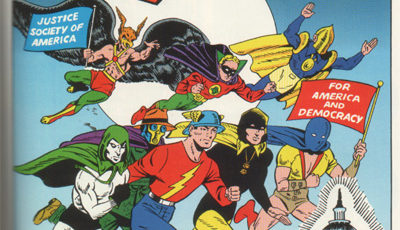
That was what DC Comics editor Julius Schwartz must have been thinking in late 1959, as he prepared for the debut of the latest feature in his burgeoning line of super-hero titles. He had already revived the Flash and Green Lantern in the pages of the anthology book SHOWCASE, both of which had attained such success at the cash register that they had received (or were about to receive, in Green Lantern’s case) their own magazine. So what next? The choice for Schwartz was obvious: one of the biggest successes for National Comics in the 1940s, the Justice Society of America. However, he wasn’t crazy about the name. “To me, ‘Society’ meant something you found on Park Avenue. I felt that ‘League’ was a stronger word, one that the readers could identify with because of baseball leagues,” explained Schwartz in 1977 (in issue #14 of the in-house DC fan magazine THE AMAZING WORLD OF DC COMICS). So then was born the team that would solidify DC Comics’ full-time return to the superhero business, and whose success would not only herald the introduction of scores more superhero titles at DC, but also inspire DC’s rival Martin Goodman at Marvel to instruct Stan Lee to create their own superhero team, thereby kickstarting the Marvel Universe as well. Of course, I’m talking about the Justice League of America.


While the name was changing, the basic concept was not. So who then would be drafted into Schwartz’s new “Justice League of America”? To start with, Flash and Green Lantern, Schwartz’s new rising stars, were a given. Wonder Woman still had her own solo magazine, so she was included as well. Aquaman was nestled into a monthly spot backing up Superboy in ADVENTURE COMICS, so he got the call, as did J’onn J’onzz, the Martian Manhunter. Who, you ask? Ah, yes; J’onn J’onzz, the “Pete Best” of the Justice League as far as the general public is concerned.

J’onn, a.k.a. the Martian Manhunter, was a holdover from the sci-fi craze in comics in the late 1950s. Premiering in 1955 as a backup feature in DETECTIVE COMICS, J’onn was a Martian accidentally teleported to Earth by the well-intentioned if somewhat skittish scientist Professor Mark Erdel, who dropped dead from shock at the sight of the newly arrived Martian.


Stranded on Earth but basically a decent sort, J’onn anglicized his name to the more American-sounding John Jones, and made use of his Martian ability to shapechange to pose as a human. J’onn began work as a police detective, occasionally acting in public in his Martian form as well, using his other Martian powers in superheroic fashion. And there were quite a few of them — aside from the shapechanging, J’onn could fly, turn invisible, read minds, and he was super-strong. Plus, there was the ill-defined and infrequently used Martian vision and Martian breath. However, J’onn wasn’t infallible, and in fact was extremely vulnerable to fire. Anyway, by the time JUSTICE LEAGUE OF AMERICA was being created, J’onn J’onzz had been a monthly six-page fixture in the back of DETECTIVE COMICS for over five years, which certainly qualified him for a spot on the team. Unfortunately, the character had been written out of the book by the time Hanna-Barbara premiered its first animated version of the Justice League in the first season of the Saturday-morning series SUPERFRIENDS in 1973, so several generations of youngsters who would later become comics fans would no doubt eventually pick up a Justice League comic and go “Who’s the bald green guy?”

But what about the two biggest guns in DC’s arsenal, Superman and Batman? Surely their inclusion should have been a no-brainer, right? Not so fast.

As it turned out, there was some resistance to the inclusion of the Big Two in Schwartz’s new League, namely from Superman editor Mort Weisinger and Batman editor Jack Schiff. In that same issue of AMAZING WORLD OF DC COMICS, Schwartz recalled that the two editors, fiercely protective of their own successful territory, were against the inclusion, arguing that “the heroes might become overused and it would take away from sales on their books.” A compromise was struck, in which Superman and Batman were included as full members, but would play decidedly small parts in the adventures (often being busy in outer space or on other missions) and would not appear on the cover. Schwartz diplomatically handled the inevitable questions from fans asking about Superman and Batman’s absence, writing in the first JLA letter column in the team’s third appearance that “these two popular heroes appear in so many other DC magazines that we thought it would be more appropriate to play up the other members.” As the story goes, this policy continued throughout much of the series’ first year of publication, until DC’s publisher at the time asked Schwartz why he never saw Superman or Batman on the cover of JUSTICE LEAGUE OF AMERICA — didn’t he think it’d be good for sales? Sheepishly, Schwartz explained the agreement he’d made with his fellow editors, to which the publisher roared, “You go tell those so-and-so’s that DC Comics owns Superman and Batman, and not Mort Weisinger and Jack Schiff!” Whether the story is true or not, it wasn’t too long before both Superman and Batman were taking part in the adventures and being featured prominently on the covers.

When it came to choosing a creative team, Schwartz went right to his best and most obvious choice for a writer: Gardner Fox, longtime writer of the original comic-book super-team, the Justice Society of America. Fox had established a sturdy formula for this type of team book back in the 1940s, in which the JSA would gather at the beginning of the issue when the threat appeared, break up into solo or smaller-group adventures and then reunite for the grand finale. No need to mess with a good thing, as that would become the schematic for countless JLA stories to come, whether by Fox or one of his many successors.

As for the art, Schwartz selected Mike Sekowsky, who had been working primarily on DC’s science-fiction titles before being pressed into service on this, certainly one of the more high-profile assignments at the company. Sekowsky’s art is far from flashy, and yet there’s a crude brilliance to it that seems a perfect fit for the title; it somehow seems to be simultaneously both futuristic and fairy-tale simple.


Sekowsky’s figures weren’t the most heroically cut — sometimes the Justice League looked like a bunch of middle-aged businessmen dressed up for a Kiwanis Club masquerade party — his backgrounds were usually sparsely detailed and occasionally his anatomy could get a little, shall we say, creative.


Still, his JUSTICE LEAGUE OF AMERICA looked like nothing else in the rack at the time, and I think the fact the League members looked decidedly different in the pages of JLA compared to their solo books actually helped break out the series as its own animal, and did much more for its success than having a flashier, more polished artist would have.

Schwartz scheduled the series for a three-issue tryout in the pages of THE BRAVE AND THE BOLD, another of DC’s anthology books, and in March 1960, B&B #28 featured the first appearance of the Justice League of America in their debut adventure, facing off against the alien threat of Starro the Conqueror in the logically named story “Starro the Conqueror!”


As was a bit more common at the time than it is now, editor Schwartz and writer Fox dispensed with an origin story, instead dropping the reader into the action at a point after the League had already formed and been in service for some time, at least long enough to have already passed out signal devices and constructed a secret (and, for the time, rather stylish) headquarters. As the story begins, Aquaman is warned by a friendly puffer fish of the arrival of a mysterious giant starfish. From space. As the puffer fish explains to Aquaman, the giant starfish arrived and swiftly changed three local starfish into duplicates of itself, introducing himself as “Starro,” and declaring his intention to conquer the planet. Naturally concerned, Aquaman summons his fellow Justice League members, who convene at their headquarters to discuss the matter (with the glaring exception of Superman and Batman — Superman is stopping a meteor shower, while Batman is tracking down two suspiciously vague “archenemies.” Sounds like something you say when you’re trying to get out of dinner plans…).


The League members split up to handle Starro’s three newly created starfish deputies, with Green Lantern defeating one in the Rocky Mountains, Wonder Woman and J’onn J’onzz taking out a second one in Science City, and Flash tackling the third in the small coastal community of Happy Harbor.


Flash discovers Starro’s main power, aside from being, well, a really big starfish: mind control. Starro’s deputy has mentally enslaved the entire population of Happy Harbor, except for one person: the teen hipster “Snapper” Carr, who remains mysteriously immune. After Flash defeats the giant starfish, he heads off to confront Starro, with the annoying Snapper in tow. Snapper, by the way, received his nickname for his incessant habit of snapping his fingers in appreciation of anything he liked. I think nowadays that’s considered a mild form of autism…


The assembled Justice League attacks Starro, who’s considerably more formidable than his invertebrate underlings, having mentally received all the knowledge and experience from their battles with the League. Starro reads Green Lantern’s mind and learns of his weakness against yellow, and quickly changes his skin color so as to render GL’s ring useless.


Flash, meanwhile, is still mulling over why Snapper would be immune to Starro’s mind control, and after a quick chemical analysis detects traces of lime adhering to Snapper’s body and clothes. (Apparently “lime-ing” the lawn was a necessary chore in the ’60s…)


Realizing that fishermen use quicklime to eliminate starfish and oysters (a fact you’d think Aquaman would be a little more angry about), Green Lantern borrows some barrels of lime from some nearby farmers and encase Starro in an unbreakable shell of lime, helpfully applied by J’onn J’onzz in a rare use of his “Martian breath.”


With Starro defeated, the Justice League reward Snapper Carr for essentially standing around and adding little of value, declaring him an honorary member of the League and giving him a JLA signal device.


Little did they know that their kind gesture of pity to a clearly troubled young man would result in this punk practically living in the Justice League’s Secret Sanctuary for the next five years or so.

(As a side note, the League’s first recorded battle with Starro set off a mysterious trend of practically all of the Justice League’s recurring opponents having a name ending in the letter “o.” Starro was followed by Professor Ivo and his android Amazo, after which came Despero, and after that Kanjar Ro. The hidden message here? Gardner Fox liked the letter “O.” That’s all I got.)

Unsurprisingly, the first three-issue Justice League run in BRAVE AND THE BOLD was a big success, leading to the first issue of their own series, JUSTICE LEAGUE OF AMERICA, only two months later, in November 1960. However, it wasn’t until over a year later, in JUSTICE LEAGUE OF AMERICA #9 (February 1962), that we finally learned the team’s origins in the ever-so-logically named “The Origin of the Justice League!” by the usual team of writer Gardner Fox and artist Mike Sekowsky.


The story opens with JLA mascot Snapper Carr being put to work by Wonder Woman in the Secret Sanctuary, mopping the floor and doing some light dusting. While cleaning, Snapper notices a display case filled with wooden splinters, which leads to the story of the Justice League’s first case, which apparently took place three years previously. The action had begun when J’onn J’onzz investigated a nearby town in which all the residents had been turned to stone by a mysterious stone giant.


J’onn reads the giant’s mind to get the 411, and learns that the stone giant is just one of seven aliens from the planet Appellax, who had come to Earth via meteor in order to determine (by combat, naturally) which of them would become the next ruler of their world. J’onn manages to defeat the giant, and after telling the local police to bust him up with sledgehammers (!), he heads off to track down the only Appallaxian that has not yet hatched from its meteor, just off the Carolina coast, only to find himself being transmogrified into wood by whatever is inside the meteor.


It’s the same story for Aquaman, who faces off against a crystal alien deep beneath the surface of the ocean, and Wonder Woman, who battles a liquid mercury creature on Paradise Island. Both heroes defeat their otherworldly opponents, head for Carolina and get themselves “treed.” Ditto for Green Lantern, who vanquishes a giant alien bird, and Flash, who douses an Appallaxian flame giant, both of whom wind up putting down roots next to the other three heroes.


As the trapped heroes watch, the Appallaxian wood creature bursts from the meteor and compels them to follow him, on the march to attack his sole remaining enemy. While marching, the heroes make use of the domino effect to free themselves, with Aquaman scraping the tree bark from GL’s ring, which then frees J’onn’s head, allowing him to use his Martian breath (again with the breath!) to knock Flash into Wonder Woman, putting her partially in range of GL’s ring, freeing her left arm and lasso, which she uses to vibrate the wood creature into splinters, after which the remaining heroes return to normal.


With the information J’onn plucked from the alien’s mind, the heroes head to the location of the last meteor: Greenland. The five heroes speed to the scene, only to find the Appallaxian diamond creature already fighting with none other than Superman and Batman. In a piece of good luck so astronomical it’s staggering, the meteor from which the creature had hatched just happened to be made of Kryptonite, putting Superman on the ropes.


Thanks to a Batplane-powered assist from the Caped Crusader, the Kryptonite is dispatched, allowing Superman to break all known laws of physics and somehow convert the diamond body of the alien back to coal. Yeah, I don’t know, either.

The alien threat averted, the seven heroes realize that “since teamwork alone had enabled us to defeat the meteor-beings, it might be wise for us to unite.” It’s the Flash who makes it official, suggesting they form “a league against evil! Our purpose will be to uphold justice against whatever danger threatens it!” And with that, the Justice League of America was born.


Comics 101, 2-15-12 – No Helmet Required: Ghost Rider

Here’s a character that’s been in the public consciousness lately for two reasons, one kinda cool, and one far more upsetting.

I’m talking, of course, about Marvel’s Ghost Rider, which is about to hit theatres again this Friday with the sequel to the Nicolas Cage-starring comic-book adaptation, SPIRIT OF VENGEANCE. Unfortunately, this premiere was marred by the news that Ghost Rider’s 68-year-old creator Gary Friedrich, who had attempted to sue Marvel for ownership of Ghost Rider and lost, had also received a judgment against him in Marvel’s countersuit, which ordered him to pay Marvel $17,000 for prints of the character he sold at conventions without Marvel’s permission, $17,000 that Friedrich simply does not have. As much as it’s easy to simply jump to conclusions about who’s right and who’s wrong, there are some shades of gray in this dispute like any other; however, you don’t have to pick sides to not want a fellow like Friedrich to be thrown out if his house, which is apparently what’s about to happen.

To that end, writer Steve Niles has done a very good thing and set up a PayPal donation site to help keep Gary Friedrich under his own roof. I’ve donated, and I hope those of you who are able and have ever enjoyed a Ghost Rider comic book, cartoon, toy and film will do the same: http://www.steveniles.com/gary.html

With the character in the news, it seemed like an opportune time to take a look back at Ghost Rider’s early days, which actually go back a little farther than most people think, all the way back to the Silver Age and the year 1967, when the first version of Ghost Rider appeared, a Western version, written by Roy Thomas and Gary Friedrich and drawn by Dick Ayers.

western.jpg

This version told the story of Carter Slade, who rode the Old West fighting evil as the Ghost Rider, in a glowing phosphorescent costume given him by Flaming Star, a Native American medicine man. This version of the Ghost Rider, essentially a Wild West Batman scaring galoots and roughneck train robbers into thinking he was some sort of evil spirit, only lasted seven issues, and made sporadic guest appearances in Marvel’s other Western comics in the years following.

But the name was too good to lay fallow. As the story goes, when Friedrich was writing DAREDEVIL in the early ’70s, he suggested to editor Roy Thomas that they introduce a weird motorcycle-riding villain called “Ghost Rider.” Thomas reportedly responded that the idea was too good to waste on a villain, and plans then went forward to give Friedrich’s new “Ghost Rider” character his own feature. As for who came up with what, recollections vary. Thomas contends that Friedrich was absent when he and artist Mike Ploog designed the character, with Thomas claiming credit for the character’s jumpsuit, reminiscent of Elvis’ leather outfit from the 1968 comeback special, and crediting Ploog with the notion of the flaming skull. Friedrich counters that the flaming skull was always his idea, while Ploog doesn’t recall who came up with the flaming skull idea, but notes that the tunic design was taken from the original Western character, while the blue stripes on the jumpsuit’s arms and legs were merely to allow the rest of the suit to be rendered as black as possible.

Creative credit aside, the character made his premiere in August 1972, in MARVEL SPOTLIGHT #5, in a tale logically titled “Ghost Rider,” written by Gary Friedrich and drawn by Mike Ploog.

spotlight.jpg

Let me tell you, this is one weird comic book. I can’t imagine Marvel putting a book out like this today, as our hero Johnny Blaze has one of the weirdest and most disturbing origins of any superhero I can think of.

He just straight-out sells his soul to the devil. Not Mephisto, or some made-up Marvel analogue. Old Scratch. The capital-D Devil. Satan himself.

Seriously.

We first meet Johnny Blaze as a little tyke, when his father, a motorcycle stunt rider, is killed in a fiery wreck, and he’s adopted by his father’s partner in the stunt show, Crash Simpson.

IMG_4673.jpg

Tragedy strikes again when Johnny is fifteen, when his adoptive mother is killed in another motorcycle-related-accident.

IMG_4674.jpg

Despite a deathbed promise to his dying mother not to ride again, Johnny continues to practice in secret, while Crash thinks the worst:

IMG_4676.jpg

More years pass, and Crash’s motorcycle stunt show gets its biggest break ever: a gig at Madison Square Garden. Unfortunately, Crash can’t enjoy the good news:

IMG_4677.jpg

Despite the entreaties of Crash’s daughter Roxanne, whom Johnny had fallen in love with, Johnny still refuses to ride in the show. A decision that is not met with understanding:

IMG_4678.jpg

So put yourself in Johnny Blaze’s shoes. Your girl is upset, and your adoptive father is dying of cancer. You can make everyone happy by breaking a promise to your departed mother. Do you have any other options?

IMG_4679.jpg

Of course you do. Paint a pentagram on your chest and start praying to Satan.

IMG_4680.jpg

Wow. Johnny needs to work on his decision-making.

So of course, Satan shows up and offers Johnny a deal:

IMG_4681.jpg

Weeks pass, and Crash decides to perform at the MSG show, and not only that, try for the world’s cycle jump record. What could possibly go wrong?

IMG_4682.jpg

How does Johnny react to the horrible, mangled death of his adoptive father? Does he comfort Roxanne? No, he decides to try the jump himself.

IMG_4683.jpg

Johnny makes it, but Roxanne naturally isn’t too pleased with his one-upmanship while Daddy Crash’s body hasn’t even gone cold. However, Johnny has even worse problems, with another visitor to his dressing room:

IMG_4684.jpg

But before Satan can take possession of Johnny’s soul, Roxanne comes to the rescue:

IMG_4685.jpg

How does Roxanne know what to do, you might wonder?

IMG_4686.jpg

So your boyfriend has big stacks of books about Satan, and rather than asking him what exactly is going on, you read up on how to make the devil take a powder? Man. That’s love. And a surprising amount of forethought.

So Johnny thinks he’s out of the woods. At least until that night. When, you guessed it, his head spontaneously catches fire.

IMG_4687.jpg

Not only that, now he can spontaneously generate fire, or more specifically “hellfire,” as he calls it.

IMG_4688.jpg

This, then, is Johnny Blaze’s curse. Every night he transforms into the Ghost Rider, with Satan still out there scheming to collect on his soul. And all this was just the first issue. It would get much worse, and much weirder, in the issues to come. Come on back next week and see.

Scott Tipton is looking forward to talking about the best Ghost Rider villain ever. If you have questions about Ghost Rider or comics in general, send them here.

T minus 5 days and counting…

Come see our L.A. location!
5118 Lankershim Blvd
North Hollywood, CA 91601
(818) 980-BOOK

Connect With Us

Search